To compete in the literbike supersport category, manufacturers must ensure their sportbikes excel on the racetrack, and all the current top-line offerings perform wonderfully on a closed course. But this intense focus on track performance impinges on a bike’s ability to be comfortably versatile in the myriad duties called upon from a streetbike – from commuting to sport touring.
To some, usually more “experienced” riders, an XYZ1000 is too big a handful when riding on public roads, and they’re willing to sacrifice a little sport for some extra comfort and versatility. We’ve seen several softer-edged literbikes over the years – Suzuki’s Bandit, Kawi’s ZRX1100/1200, Yamaha’s FZ1 and Honda’s 919 – but they’ve been generally rejected by sportbikers who want lighter and faster machines with contemporary chassis and brakes. The word “detuned” has a negative aura, and many riders say all they want is a supersport literbike with a more comfortable riding position.
Kawasaki’s recent Ninja 1000 is perhaps the best bridge between supersport and sporty literbikes, offering strong midrange power, a stiff aluminum frame and a largely adjustable suspension with comfortable ergonomics. For many, it squarely hits the mark.
But for riders who want the ultimate, the Ninja 1000 doesn’t quite fit the bill, complaining of a detuned motor and a few too many extra pounds. For them, they are happier modifying a top-shelf literbike to make it more accommodating and versatile.
So, when we were offered a friend’s ZX-10R that had been modified for greater comfort, we decided to take it for a ride with the Ninja 1000 to find out how these two competing rules of thought compared with each other. Let the debate rage on in the forum! –Kevin Duke, Editor-in-Chief
Can you build a better supersport-tourer than Team Green? Kawasaki designers and engineers tasked with constructing the 2011 Ninja 1000 have one enormous disadvantage; their bike must appeal to many, whereas modifying an existing supersport requires approval from only its creator.
The newest Ninja isn’t the first motorcycle catering to maturing sportbike riders who, ignoring aging joints and creaking backs, are unwilling to purchase an “old man’s bike.” The problem with the Ninja 1000, as with all motorcycles of its ilk, is there’s no consensus defining the right balance of performance and comfort. Unlike its forebears, such as the ill-handling Suzuki Bandit 1200 or the peaky engine performance of the Yamaha FZ1, the new Ninja 1000 is the best contribution from an OEM to the supersport-touring genre, blending a torquey engine with ample mid-range power with sportbike-like handling from its capable chassis.
Adapting the uncompromising ergonomics of a performance-bred sportbike into one’s own interpretation of that perfect balance of go-fast performance and long-distance comfort, that oftentimes includes luggage and/or two-up riding, is one option to buying a pre-fab supersport-tourer like the Ninja 1K.
The 2005 ZX-10R seen here personifies the transformation of a supersport into a supersport-tourer with selective aftermarket equipment. Its owner, working on past experiences with a Bandit 1200 and Yamaha FZ1, determined that none of the OEMs were building a bike specific to his personal tastes in a sportbike. His solution is a Kawi 10R with its performance intact and comfort increased enough to make a cross-continent ride (which the bike’s owner did last year) enjoyable instead of merely endurable.
Opening up the cockpit is a no-brainer when incorporating more comfort into a motorcycle built for speed. The MFW footpegs and extensions on the 10R provide two inches of added legroom. The MFW footpegs are adjustable, rotating around its mounting point to increase and decrease ground clearance. Measuring while in the footpeg’s lowest setting to the top of the seat, there was about 0.7 inch more distance compared to the same measurement on the stock Ninja 1000. So already we have a supersport bike with more legroom than a bike designed for the purpose.
The HeliBars TracStar handlebars raise the 10R’s rider 1.75 inches higher than stock clip-ons. The HeliBars on the ZX reduce the weight carried by the rider’s wrists while maintaining an aggressive forward lean, but unlike the MFW footpegs, they do not offer further adjustability.
The handlebars on the new Ninja aren’t adjustable but what they are is very tall - they have the rider sitting bolt upright in the seat. This position, while comfortable, hampers feedback from the front end and snail-mails a vague feeling of what’s going on at the front tire.
The Ninja is capable of hustling down a twisty two-laner, matching the pace of the ZX, but the Ninja’s detached-feeling front end, relative to a ZX-10R, is disconcerting when ridden at an aggressive pace. For the motorcyclist living in a state with more straight roads than curvy, the combination of higher handlebars and upright seating position will likely be seen as an attribute rather than a design flaw.
 The Ninja 1000 is capable of holding its own against racier machines. It's only performance flaw is its uncommunicative front end.
Kawasaki’s recent Ninja 1000 is perhaps the best bridge between supersport and sporty literbikes, offering strong midrange power, a stiff aluminum frame and a largely adjustable suspension with comfortable ergonomics. For many, it squarely hits the mark.
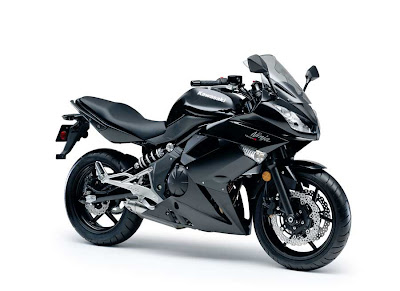
 The 2011 Kawasaki Ninja 1000 is an excellent blend of sport and streetability. But is it a better streetbike than a comfort-modified ZX-10R? |
So, when we were offered a friend’s ZX-10R that had been modified for greater comfort, we decided to take it for a ride with the Ninja 1000 to find out how these two competing rules of thought compared with each other. Let the debate rage on in the forum! –Kevin Duke, Editor-in-Chief
Can you build a better supersport-tourer than Team Green? Kawasaki designers and engineers tasked with constructing the 2011 Ninja 1000 have one enormous disadvantage; their bike must appeal to many, whereas modifying an existing supersport requires approval from only its creator.
The newest Ninja isn’t the first motorcycle catering to maturing sportbike riders who, ignoring aging joints and creaking backs, are unwilling to purchase an “old man’s bike.” The problem with the Ninja 1000, as with all motorcycles of its ilk, is there’s no consensus defining the right balance of performance and comfort. Unlike its forebears, such as the ill-handling Suzuki Bandit 1200 or the peaky engine performance of the Yamaha FZ1, the new Ninja 1000 is the best contribution from an OEM to the supersport-touring genre, blending a torquey engine with ample mid-range power with sportbike-like handling from its capable chassis.
 With streetable mid-range power and comfy yet sport ergos, the 2011 Ninja 1000 is the best supersport-tourer to yet come from an OEM. |
The 2005 ZX-10R seen here personifies the transformation of a supersport into a supersport-tourer with selective aftermarket equipment. Its owner, working on past experiences with a Bandit 1200 and Yamaha FZ1, determined that none of the OEMs were building a bike specific to his personal tastes in a sportbike. His solution is a Kawi 10R with its performance intact and comfort increased enough to make a cross-continent ride (which the bike’s owner did last year) enjoyable instead of merely endurable.
Opening up the cockpit is a no-brainer when incorporating more comfort into a motorcycle built for speed. The MFW footpegs and extensions on the 10R provide two inches of added legroom. The MFW footpegs are adjustable, rotating around its mounting point to increase and decrease ground clearance. Measuring while in the footpeg’s lowest setting to the top of the seat, there was about 0.7 inch more distance compared to the same measurement on the stock Ninja 1000. So already we have a supersport bike with more legroom than a bike designed for the purpose.
 Taming this beast is a host of aftermarket equipment including: HeliBars TracStar handlebars, MFW footpegs, MRA windscreen, MFA mirror extenders, ASV levers, Yoshimura RS-3 full exhaust (with quiet endcap), Dynojet Power Commander PCIII, Sargent Cycle custom seat. |
The handlebars on the new Ninja aren’t adjustable but what they are is very tall - they have the rider sitting bolt upright in the seat. This position, while comfortable, hampers feedback from the front end and snail-mails a vague feeling of what’s going on at the front tire.
The Ninja is capable of hustling down a twisty two-laner, matching the pace of the ZX, but the Ninja’s detached-feeling front end, relative to a ZX-10R, is disconcerting when ridden at an aggressive pace. For the motorcyclist living in a state with more straight roads than curvy, the combination of higher handlebars and upright seating position will likely be seen as an attribute rather than a design flaw.
The Ninja 1000 is capable of holding its own against racier machines. It's only performance flaw is its uncommunicative front end.Once rolling, the prodigious power of either bike will make a rider smile. But where the Ninja exudes highly usable mid-range torque, the ZX requires spinning up RPMs. This is a stark difference between engines constructed for differing purposes; Ninja for the street, ZX for the track.
Around town the ZX requires more clutch-work leaving stop lights and performing slow maneuvers, and doesn’t like minimal throttle inputs at low revs. The more streetable Ninja engine performs parking lot maneuvers without unnecessary difficulty, aided by a wider degree of range between steering stops and an easy-to-modulate clutch.
“The Ninja is a stoplight demon,” remarked Chief Duke. “If you set the revs at 4500, you can gracefully loft the front wheel across an intersection from a dead stop. This kind of ferocious low-speed launch is simply unavailable to the peakier and taller-geared 10R. The Ninja’s stout midrange power and more rational street gearing is also superior in highway roll-on situations.”

The Ninja's 3-way adjustable windscreen is both simple and functional.
On the freeway the ZX’s MRA touring windscreen diffuses wind better than its original counterpart and without any problematic buffeting. The Ninja utilizes a three-way (low, mid, high) adjustable windscreen, a useful and welcome feature that adapts to your preferences.
One area where you’ll have trouble bettering an OEM-built supersport-tourer is in the passenger accommodations department. The Ninja has a broader and better padded pillion saddle than you’ll find on any supersport, plus considerably more legroom. Your co-pilot will also appreciate large rubber-damped grabrails that can double as handy bungee hooks when traveling solo.
A lot of what was done to this ZX-10R, such as upgrading the suspension via Race Tech, bolting on ASV levers and adding a Scotts steering damper and steel braided lines could just as easily be applied to the Ninja. So, again, is it better to tourize a supersport bike or modify and add performance to a potentially near-miss model such as the Ninja 1000?
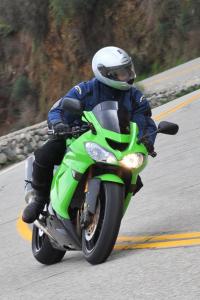
Great on fast, flowing twisty roads, the ZX isn't as cooperative as the Ninja in the city.
MO guest tester and supersport-touring GSX-R1000 owner, Glenn Giardinelli, commends the Ninja but isn’t running out to buy one. “Kawasaki made a valiant effort at trying to capture what many people want: something fast, exciting, modern and moderately comfortable,” he says. “But, if you are a sportbike devotee like I am, the new Ninja 1000 will likely not be your cup of tea. It just doesn't feel/handle like a pure sportbike.”
“I've learned,” he continues, “that I can make a sportbike more user friendly just by adding a few aftermarket items and, most importantly, without changing the characteristics I love most about sportbikes.”
The owner of this ZX-10R, Eric Putter, concurs. “Would I trade in my Supersport-tourer for shiny, new tackle? With all due respect to Kawasaki, I’ll take my stronger, lighter, better-suspended, five-year-old workhorse over the new Ninja.”
These two knee-draggers only reflect riders emphasizing speed over comfort. But, as mentioned elsewhere in this story, the Ninja is fully capable of pacing the ZX in most street riding situations. So preference for customizing your own supersport-tourer could be a matter of personal enjoyment in tweaking a motorcycle for the simple pleasure of spending time in the garage with your bike.
If you already own a supersport bike, the savings in modifying it for supersport-touring duty are substantial compared to purchasing a new bike. Upgrades to this 2005 ZX-10R (Kelly Blue Book value of approximately $5,500) amounted to about $5,700, adding up to $11,200 total cost. A 2011 Ninja 1000 retails for $10,999.

If, however, purchasing a new supersport is required, the MSRP on a 2011 ZX-10R is $13,799 ($14,799 with ABS). Add $5,700 in upgrades and suddenly that Ninja 1000 is looking $8,500 more affordable.
If you purchased your supersport bike new, you know its history. On the flip side, there’s always a risk when buying a used sportbike, as you never can be sure of its history. Purchasing a new Ninja 1000 comes with perks such as ensuring proper break-in yourself and the security of a warranty.
Technology is an advantage supersport bikes are going to have over their supersport-touring counterparts. The 10R here features a slipper clutch which is unavailable for the Ninja 1000. Newer supersport bikes are coming with traction control which probably will not trickle down to bikes such as the Ninja 1000 for years to come. The 2011 ZX-10R adds traction control and optional ABS — for a steep price increase ($14,799 w/ABS) over the Ninja 1000.
Strengths and weaknesses exist for both of these bikes, and the choice ultimately comes down to the effort you’re willing to exert and how particular you are about your ride.
For those who are less exacting, the Ninja 1000 may satisfy just the way it sits. Or, possibly, some lower handlebars to weight the front end and (hopefully) solve the vagueness issue could turn the new Ninja into one of the best supersport-tourers available. Other considerations include optional Kawasaki accessories such as hard saddlebags and top box and heated handgrips. Kawasaki even saw fit to add a vibration-damping weight to the backside of the footpeg guards (not that either bike displayed obnoxious vibrations).
 Constructing your own supersport-tourer can be rewarding for those willing to modify it to their tastes. But, in several ways, the 2011 Ninja 1000 is a more complete streetbike. |
For true performance enthusiasts and tireless tinkerers, no supersport-tourer yet built by an OEM can match the one constructed in your own garage. Personalization is king, and although there were (what I thought to be) quirks with Mr. Putter’s ZX-10R, he couldn’t be happier with his creation. Just as Kawasaki didn’t build the Ninja 1000 to personally appease him, he didn’t construct his ZX-10R to satisfy me.